
I opened my front door one afternoon, arms full of groceries, and nearly went down over a pile of shoes. Four kids, two adults, one small landing spot by the door. It looked like a shoe store had exploded.
Guests saw that pile before they saw anything else about my home. That was the moment I decided something had to change, without turning my entryway into a boring storage closet. What I found were five simple setups that handle a busy family every single day and still look like a space I’m proud to walk through. Here they are, along with the exact products that make them work.
Top 5 Products for Entryway Shoe Storage
- Prepac Store Shoe Storage Cubbie Bench [Amazon link] — A cottage-style bench with open cubbies that holds up to 18 pairs, giving every family member their own spot.
- Songmics Bamboo Entryway Storage Rack [Amazon link] — A sturdy bamboo bench built for boots and shoes of different heights, made for a household with mixed shoe sizes.
- HOMCOM Rattan Shoe Storage Bench with Cushion [Amazon link] — A cushioned bench with woven rattan doors that hides shoes completely while adding a soft, styled texture.
- StorageWorks Water Hyacinth Woven Baskets [Amazon link] — Natural woven baskets that catch loose shoes and look like intentional decor, not overflow storage.
- Convenience Concepts Console Table with Shelf [Amazon link] — A slim console table with an open lower shelf, perfect for a narrow entryway that still needs a styled surface up top.
The Storage Bench That Doubles as Seating and Shoe Catch-All
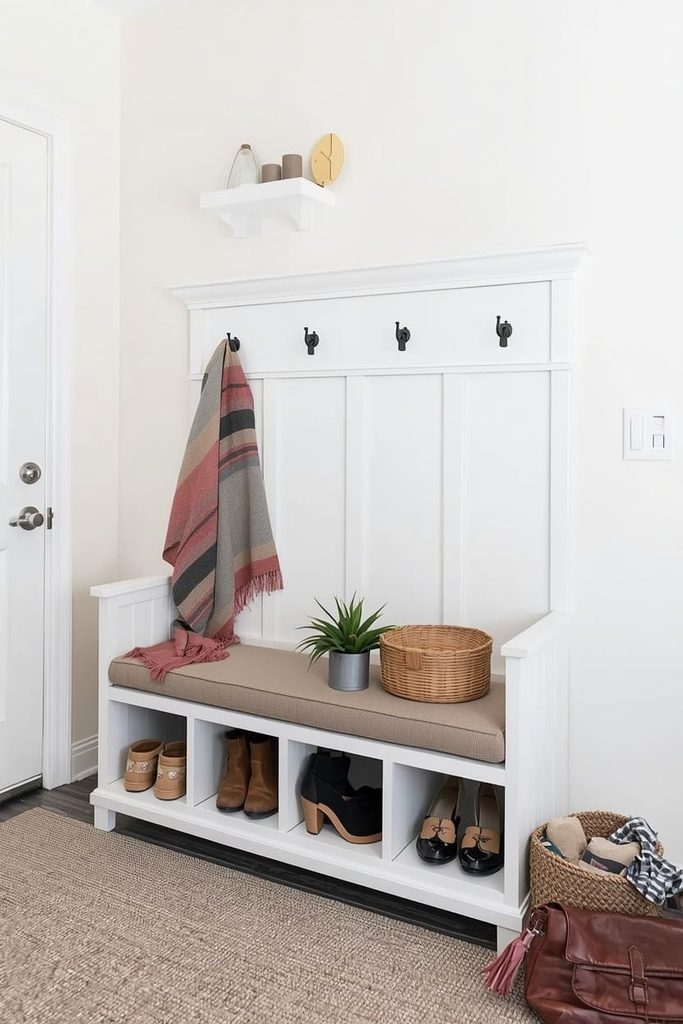
A storage bench gives your family a place to sit while taking shoes off, with open cubbies or hidden storage built right underneath.
This solves two problems at once. Kids and adults both sit down to remove shoes anyway, so the storage might as well live exactly where that happens. A bench also reads as real furniture, not a shoe pile, which changes the whole feel of the space.
Here’s how to set it up:
- Measure your entryway width before buying, leaving room to fully open the front door.
- Choose a bench with individual cubbies if you have more than two people using the space daily.
- Assign one cubby or section per family member to cut down on mixed-up shoes.
- Add a folded throw or a small pillow on top to soften the look for guests.
Tip: Pick a bench with a washable or wipeable surface if muddy shoes or wet boots are a regular part of your routine.
I resisted a bench for years, thinking it would eat up too much space. Once I measured and found one that actually fit, it became the busiest spot in my house. Every kid has their own cubby now, and nobody argues about whose shoes are whose anymore.
The Woven Basket Trio That Hides Daily Clutter in Plain Sight
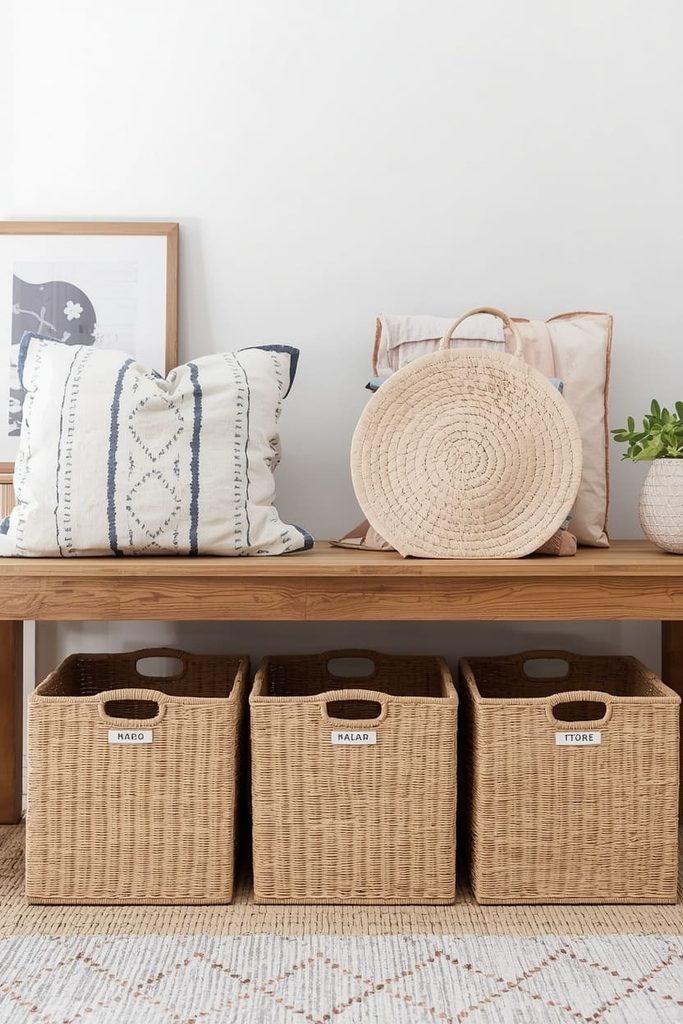
A row of matching woven baskets on the floor or a low shelf gives everyone a place to drop shoes fast, while still looking like styled decor.
Baskets work because they ask nothing of anyone. There’s no lid to lift, no cubby to remember, just toss and go. Natural materials like rattan or water hyacinth also photograph beautifully, so the same fix that solves your clutter also styles your entryway.
To set this up:
- Choose three or four matching baskets, one per family member or one per shoe type.
- Place them along a wall or under an existing shelf or bench.
- Label each basket if younger kids need a visual cue for whose is whose.
- Empty and reset the baskets weekly so they don’t become permanent shoe graveyards.
This setup also travels well if you rearrange your entryway later, since baskets need no mounting or assembly.
Tip: Choose baskets with handles so they’re easy to carry to the closet for a deeper clean when needed.
I added three woven baskets under an existing shelf on a whim, not expecting much. They ended up being the fastest fix on this whole list. My kids toss shoes in without being asked, and the baskets somehow make the whole wall look finished instead of empty.
The Enclosed Shoe Cabinet That Keeps Guests From Seeing the Mess
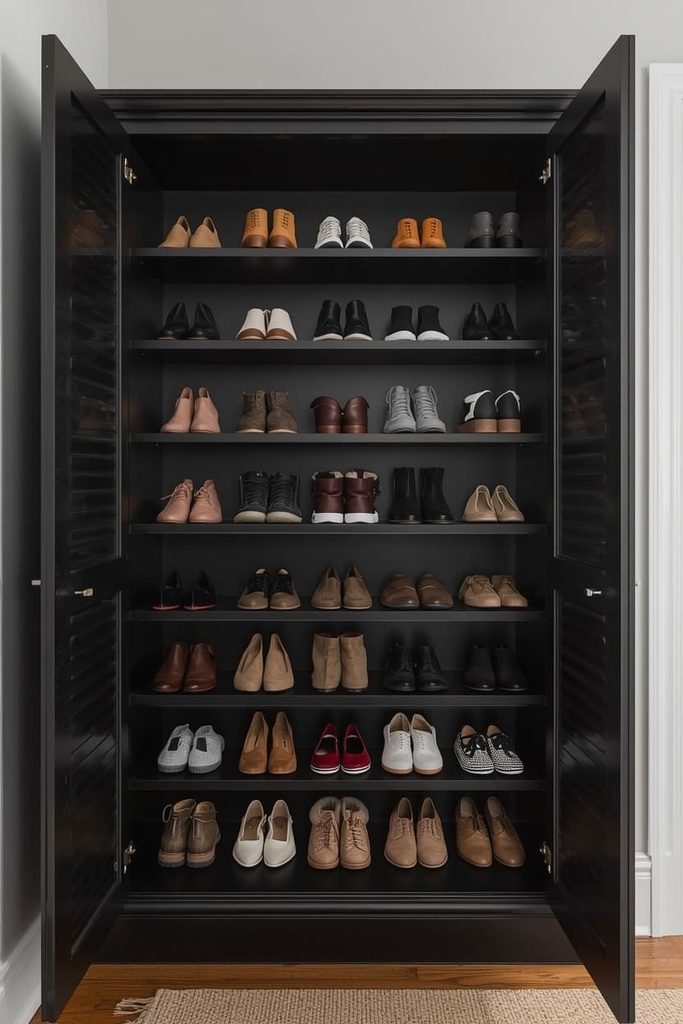
An enclosed shoe cabinet stores every pair behind closed doors, so your entryway looks clean the moment anyone walks in.
If you host often, or simply hate an exposed shoe pile, hidden storage solves the style half of the equation completely. Guests see a clean cabinet, not a family’s worth of daily shoes.
Here’s the process:
- Measure your entryway depth, since enclosed cabinets take up more space than open shelving.
- Choose a cabinet with vented or slatted doors if odor control matters to your household.
- Sort shoes by owner or category before loading the cabinet, so mornings don’t turn into a search.
- Keep one or two pairs of daily shoes outside the cabinet for the household members in the biggest rush each morning.
Tip: A cabinet with a flat top doubles as a spot for a lamp, tray, or seasonal decor, adding even more styled function.
Before guests came over, I used to do a frantic shoe-kicking sprint through the entryway. Now everything disappears behind two doors in about thirty seconds. Nobody who visits has any idea how many shoes four people can actually own.
The Console Table With Shelf Storage That Adds Style Above and Storage Below
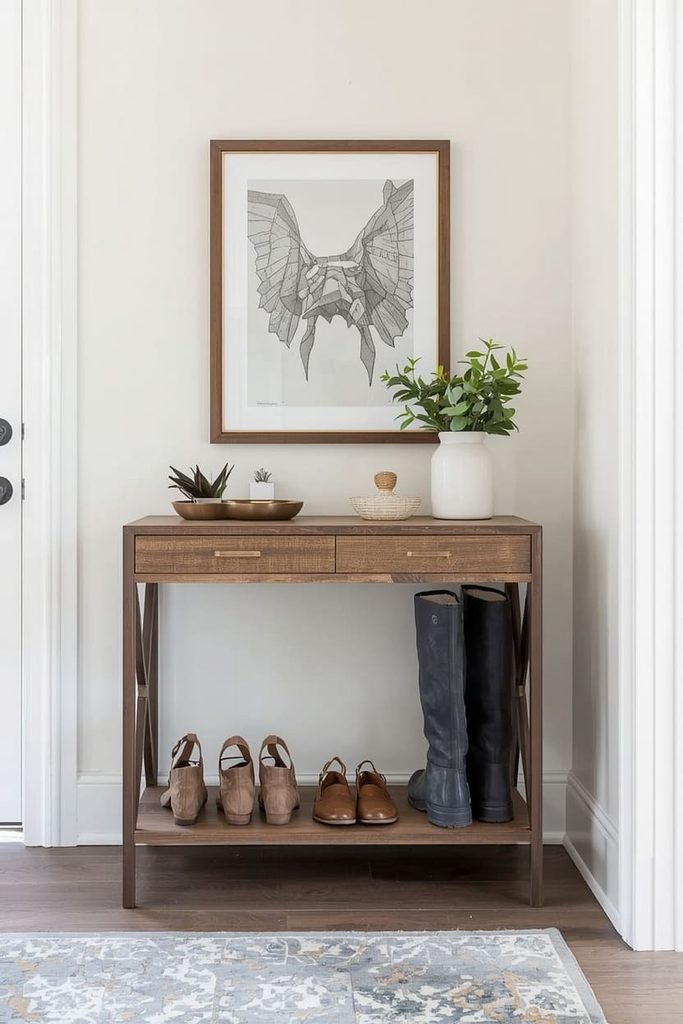
A slim console table pairs a styled tabletop surface with an open lower shelf for shoes, giving your entryway both function and a finished look.
Most entryways need a spot for keys, mail, and a small decorative touch anyway. A console table gives you that surface while quietly handling shoe storage underneath, without needing a separate piece of furniture.
To build this:
- Measure your entryway wall space, choosing a table narrow enough to leave a clear walking path.
- Place daily shoes on the lower shelf, keeping heavier boots toward the back.
- Style the tabletop with one or two simple items, like a tray or small plant, to keep the look intentional.
- Add a basket on the shelf if open shoes still look too casual for your taste.
This idea works especially well in narrow entryways, where a bulky bench might block the door.
Tip: Choose a table with a shelf lip or edge to keep shoes from sliding off during daily use.
My entryway is barely wide enough for one person to pass at a time, so a bulky bench was never going to work. A slim console table gave me a spot for keys and mail on top, shoes tucked below, and it still leaves plenty of room to walk through with arms full of groceries.
The Wall-Mounted Shelf and Hook Combo That Expands With Your Family
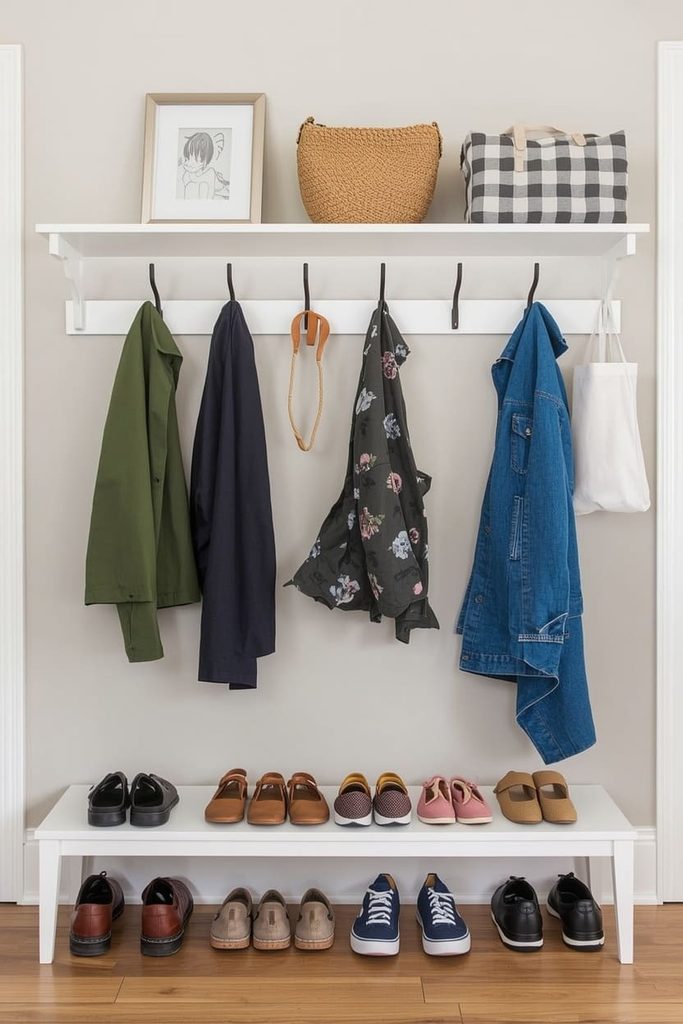
A wall-mounted shelf paired with hooks above gives you shoe storage and coat storage in one styled unit, without taking up any floor space.
Families grow, and so do their shoe piles. A wall-mounted system expands easily since you’re not limited by furniture size, just wall length.
Here’s how to install it:
- Measure your available wall space and mark stud locations for secure mounting.
- Install the shelf at a height that works for your shortest family member to reach.
- Add hooks above for coats and bags, keeping the whole entryway system in one visual zone.
- Group shoes by owner along the shelf for a system the whole family can follow.
Tip: Choose a shelf with a slightly raised front edge, similar to a chalkboard tray, to keep shoes from sliding forward.
We added this system once our kids’ shoe collection outgrew every bin we tried. A shelf and hook combo along one wall gave us room to grow without buying new furniture every year. Coats hang above, shoes line up below, and the whole wall reads as one intentional setup instead of a patchwork fix.
How to Handle Shoe Storage for a Family of Four (or More)
More people means more shoes, and one small bin rarely keeps up once your household grows.
Give each family member a dedicated zone, whether that’s a cubby, a basket, or a section of shelf. A shared, unassigned pile is where most entryway chaos actually starts.
Rotate seasonal shoes out of the main entryway system entirely. Keeping only daily pairs within reach for a family of four or more prevents the space from overflowing within a single week.
Set a quick reset routine, even five minutes on a Sunday evening. Pull out anything that’s landed in the wrong spot, wipe down muddy baskets, and confirm each family member’s zone still has room. Small, regular resets prevent the slow slide back into a pile that most busy households experience.
Involve kids in choosing their own spot within the system, even if it’s just picking a basket color. A child who feels some ownership over their storage spot is far more likely to actually use it without being reminded every day.
How to Make Entryway Shoe Storage Look Styled, Not Just Functional
The difference between a “landing zone” and a styled entryway usually comes down to a few small choices, not a full furniture budget.
Stick to one material family, like all wood tones or all woven textures, across your storage pieces. A mismatched pile of random bins and racks reads as clutter even when everything is technically organized.
Add one decorative touch above or beside your storage, whether that’s a mirror, a small plant, or a piece of art. That single detail signals “styled space” instead of “overflow storage” the moment someone walks in.
Lighting changes the whole feel too. A warm lamp on a console table or a small sconce above a bench makes the entryway feel welcoming instead of purely functional, especially in the darker months when guests arrive after sunset.
Keep the floor itself part of the plan. A simple rug or mat under your storage system anchors the whole area and hides everyday scuffs, which matters more in a high-traffic entryway than almost anywhere else in the house.
Frequently Asked Questions
What’s the best entryway shoe storage for a large family? A storage bench with individual cubbies or a wall-mounted shelf system works best for larger households. Both let you assign a clear spot per person instead of one shared pile.
How do I hide shoe clutter when guests come over? An enclosed cabinet or a set of matching lidded baskets hides shoes instantly. Both let you clear the space in under a minute before anyone arrives.
What’s the best shoe storage for an entryway with no closet? A bench, console table, or wall-mounted shelf all work well without a closet. Each adds real storage using furniture or wall space instead of a dedicated room.
How do I keep an entryway from smelling like shoes? Choose storage with ventilation, like slatted cabinet doors or open woven baskets, instead of sealed plastic bins. Airflow makes a bigger difference than any spray or scent trick.
Should I separate kids’ shoes from adult shoes? Yes, especially in a busy household. Giving kids their own low, easy-to-reach spot cuts down on both mix-ups and the temptation to just drop shoes anywhere.
Can entryway shoe storage work in a small apartment too? Yes, especially slim options like a console table or a narrow wall shelf. Choose a piece sized to your actual entryway rather than the biggest option available, since bulk furniture can make a small space feel more crowded, not less.
A Welcoming Entryway Your Whole Family Can Actually Use
You don’t need a full mudroom to fix a messy entryway. You need one system built for how your actual family comes and goes every day.
My own entryway went from a daily trip hazard to the first thing guests compliment when they walk in. It didn’t take new construction, just the right piece of furniture matched to how many people and how many shoes we really have. Pick the idea that fits your space and your family size, and give it a try this weekend. A calmer, better-looking entryway is closer than you think.

Sohel Rana is the writer, editor, publisher, and founder of The Tidy Porch. He is the man who is responsible for the craft (my wife created) being converted into a written piece. He also helps her wife (Sumona) by capturing videos of each craft. In short, he brings each craft created by her wife in front of you by transforming it into an article and a video.
