
I opened my closet one Sunday morning and just stared. Shoes everywhere. Heels tangled with sneakers, boots leaning like they were about to fall. I had the space. I just never used it right.
That closet went from embarrassing to something I actually show off, and it didn’t take a renovation. It took the right system, built for a real shoe collection, not a starter pack of five pairs.
If your closet has room but no order, these five ideas will fix both the mess and the look, plus give you the exact products to make it happen.
Top 5 Products for Closet Shoe Storage
- Crestlive Products Stackable Clear Shoe Boxes [Amazon link] — Uniform clear boxes that stack cleanly floor to ceiling, so every pair stays visible and dust-free.
- Honey-Can-Do Chrome Rolling Shoe Tower [Amazon link] — A tall, ten-row angled tower that holds up to 30 pairs while rolling out of the way when needed.
- ClosetMaid Impressions Angled Shoe Shelf [Amazon link] — A slanted three-shelf unit that displays shoes like a boutique instead of stacking them flat.
- SpaceAid Closet Shoe Organizer [Amazon link] — A hanging, over-the-rod system that fits 16 to 32 pairs without using a single inch of shelf space.
- Sorbus Shoe Slotz Shelf Risers [Amazon link] — Simple risers that turn one flat shelf into two usable levels almost instantly.
The Stackable Acrylic Box Wall That Doubles as Display
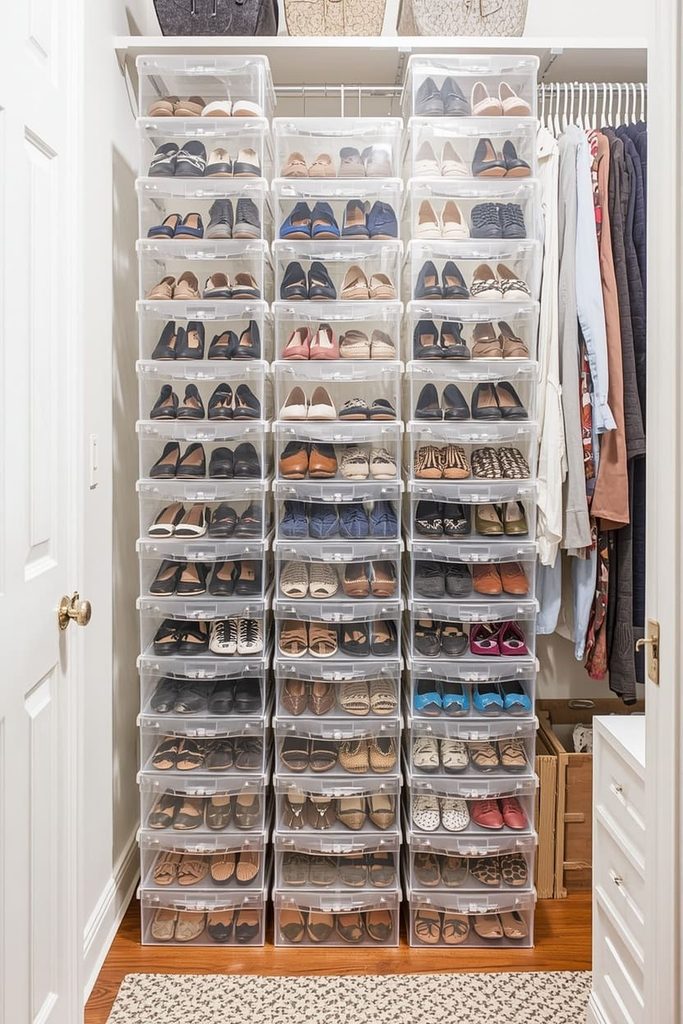
A wall of clear, stackable shoe boxes turns your closet floor into a floor-to-ceiling display, holding far more pairs than any single shelf ever could.
Stacking vertically is the single biggest space gain in most closets. Clear boxes let you see every pair at a glance, so you’re not guessing what’s inside or digging through a pile.
Here’s how to build it:
- Measure your closet’s height and depth before ordering boxes, so the stack fits without crowding the rod above it.
- Choose one consistent box style and size for a clean, uniform look.
- Stack boxes by category, dress shoes on top, everyday shoes at eye level, rarely worn pairs near the floor.
- Leave a few boxes empty at the top for new additions to your collection.
Tip: Snap a quick photo of each pair and tape it to the box front if you want a faster visual system than clear plastic alone.
I resisted clear boxes for years, thinking they’d feel too clinical for a real closet. The opposite happened. Once I stacked them floor to ceiling, my closet finally looked like something out of a catalog instead of a laundry pile with shoes mixed in.
The Angled Display Shelf That Shows Off Every Pair
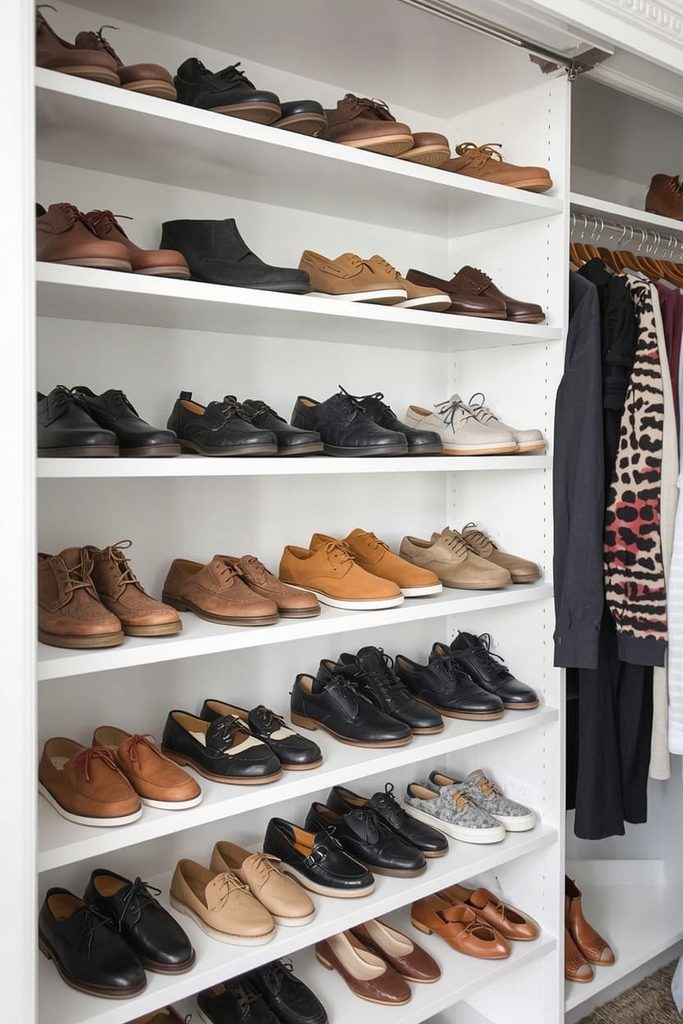
An angled shelf tilts each pair slightly forward, so you see the whole shoe at a glance instead of just the toe peeking out from a flat shelf.
Flat shelves waste visibility. You end up pulling out three pairs just to find the one you want. An angled design fixes that instantly, which is why boutiques use the same setup.
To install this:
- Measure your closet wall space and shelf depth before buying an angled unit.
- Mount or place the shelving securely, checking it can hold your shoe collection’s total weight.
- Arrange pairs from lightest to heaviest, top to bottom, for a naturally balanced look.
- Group by color gradient across each row for an instantly curated appearance.
This single change is often what makes a closet look “finished” in before-and-after photos, more than any other single upgrade.
Tip: Keep a few inches of open space at the end of each shelf so the layout doesn’t look overstuffed.
I added angled shelving to just one wall of my closet, expecting a small improvement. Instead, it became the first thing anyone notices when they walk in. Something about seeing every shoe fully, instead of just a toe, makes even a modest collection look larger and more put together.
The Rolling Shoe Tower That Holds Your Whole Collection
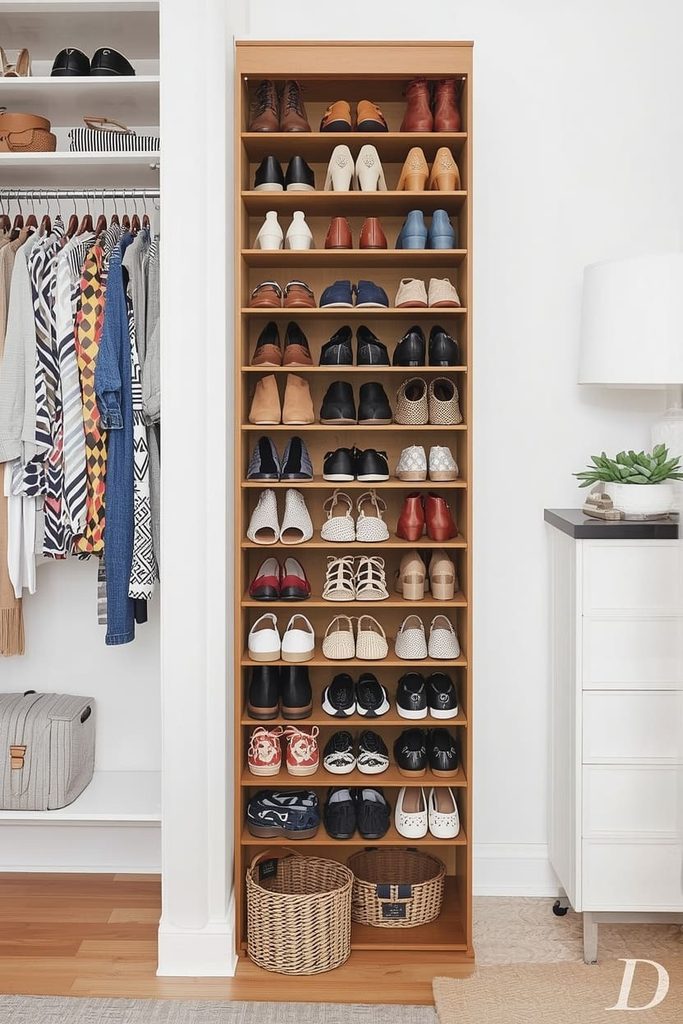
A rolling shoe tower is a tall, multi-row unit on wheels that holds dozens of pairs in one compact footprint, then rolls wherever you need it.
Closets often waste vertical space above eye level. A tower solves that by going up, not out, while wheels mean you can move it for cleaning or reorganizing without lifting a thing.
Here’s the setup:
- Measure the closet height, leaving a few inches of clearance from any shelf above.
- Slide the tower into an unused corner or against the back wall.
- Load heavier boots and shoes on the lower rows for better balance.
- Lock the wheels once it’s in its final spot so it doesn’t shift with daily use.
Tip: Keep your most-worn shoes on the middle rows, right at arm height, so you’re not bending or reaching for daily pairs.
My collection had outgrown two separate shelves before I gave in and bought a tower. It consolidated everything into one spot, rolled easily out of the way on cleaning day, and freed up an entire shelf for handbags instead. That single swap solved three problems at once.
The Hanging Rod Organizer That Uses Space You’re Already Wasting
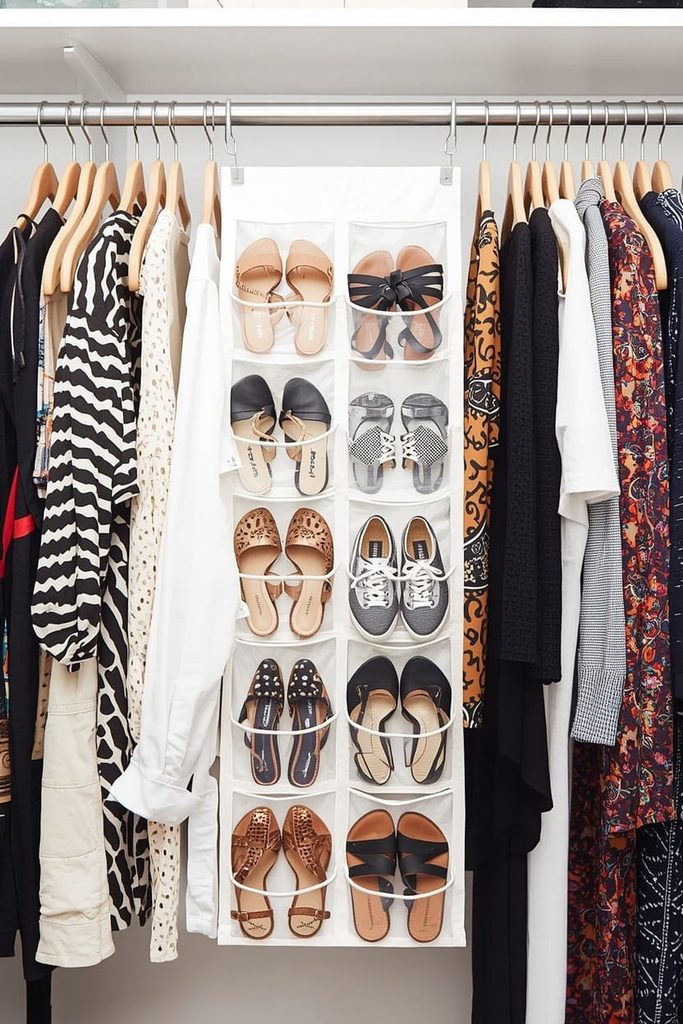
A hanging shoe organizer clips right onto your closet rod, using dead space below your hanging clothes that would otherwise sit empty.
Most closets have a foot or more of unused air beneath hanging shirts and dresses. A hanging organizer claims that space without touching a single shelf or the floor.
To set it up:
- Clip the organizer securely onto a sturdy section of your closet rod.
- Load lighter shoes, like flats and sandals, into the upper pockets.
- Save the bottom pockets for slightly bulkier pairs, like sneakers.
- Push hanging clothes slightly to one side so the organizer doesn’t crowd your outfits.
This is one of the fastest wins on this list since it adds real storage without moving a single existing shelf.
Tip: Choose a sturdy fabric organizer over a flimsy one; overloaded pockets can sag and stretch out cheap fabric quickly.
This was the very first change I made, mostly because it took ten minutes and cost almost nothing. I still use it for sandals and flats years later, tucked neatly under a row of dresses that used to hang over an empty, wasted gap.
The Shelf Riser Trick That Doubles One Shelf Into Two
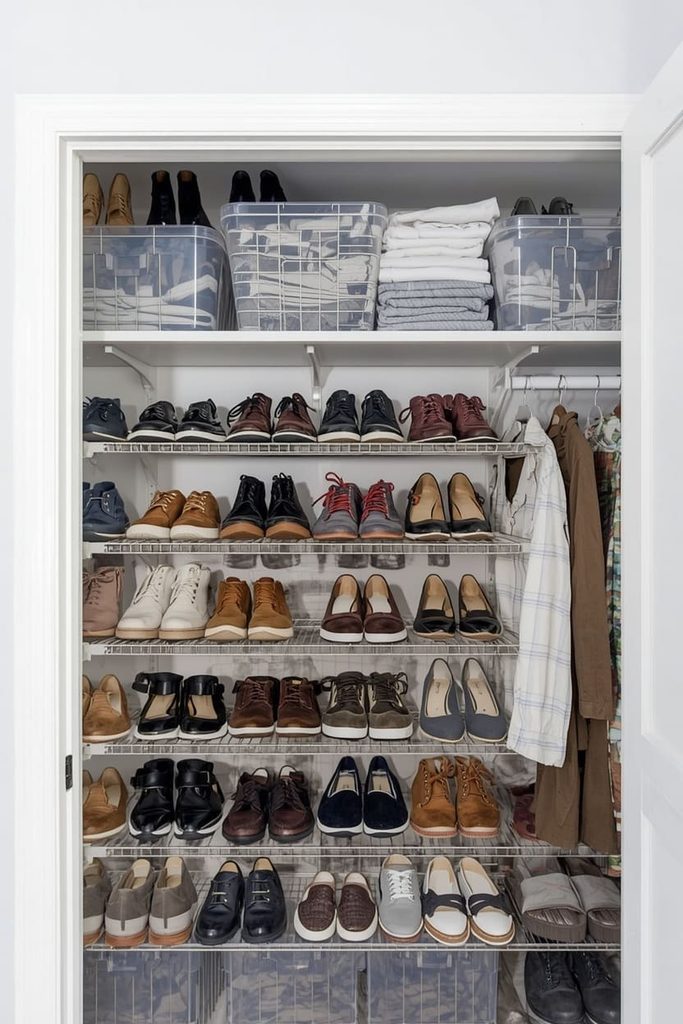
A shelf riser sits on top of an existing flat shelf, creating a second level above your current shoes without adding any new furniture.
If you already have built-in closet shelving, risers are the cheapest way to instantly double your storage on that exact shelf. No installation, no tools, just stacking.
Here’s how to use them:
- Measure your current shelf’s height clearance before buying risers.
- Place shoes on the shelf as usual, then set risers directly on top.
- Add a second row of shoes on the riser level, facing the same direction as the row below.
- Repeat across your existing shelving for a matched, doubled system.
Tip: Choose risers with a slight lip or edge to keep the top row of shoes from sliding forward over time.
I added risers to a builder-grade shelf that had always felt like wasted space above my shoes. Within minutes, that one shelf held twice as many pairs, and I didn’t spend more than the cost of a nice dinner out to do it.
How to Organize Shoes by Category So You Can Find Any Pair Fast
A closet full of shoes only works if you can grab the right pair in seconds, not minutes.
Start by splitting your collection into a few clear groups: everyday shoes, dress shoes, athletic shoes, and seasonal or rarely worn pairs. Keep everyday and dress shoes at eye level, since those get used most often.
Push seasonal shoes, like heavy boots in summer or sandals in winter, to the highest or lowest spots in your system. You’ll still have them, but they won’t crowd the space you reach for daily.
A simple label helps more than most people expect, even in a closet you know well. A small tag on a box or shelf edge saves you from second-guessing which category a pair belongs to, especially months after you first set the system up.
Revisit your categories every season. A pair that felt like an everyday shoe in winter might move to seasonal storage come summer, and keeping that shift intentional stops the whole system from slowly sliding back into a pile.
How to Make a Closet Full of Shoes Actually Look Curated
The difference between a cluttered closet and a curated one usually comes down to consistency, not the amount of storage you own.
Stick to one box style, one shelf finish, or one color scheme across your whole system. A mismatched pile of random bins never looks intentional, no matter how organized the contents actually are.
Group shoes visually, whether by color, height, or category, instead of placing them in random order as they come off your feet. A little bit of visual rhythm goes a long way toward making the whole closet feel finished.
Lighting plays a bigger role than most people think. A closet with even, warm lighting instantly makes an organized system look more like a boutique display and less like plain storage. If your closet only has one dim overhead bulb, a small battery-powered light strip along a shelf edge can change the whole feel for very little cost.
Finally, resist the urge to fill every open inch. A shelf with a little breathing room photographs better and feels calmer to open every morning than one packed edge to edge.
Frequently Asked Questions
What’s the best way to store shoes in a closet to save space? Vertical storage, like stackable boxes or a rolling tower, saves the most space. Going up instead of out lets you fit far more pairs into the same footprint.
Should shoes be stored in boxes or displayed on shelves? Both work well, and many closets benefit from a mix. Boxes protect rarely worn or delicate shoes, while open shelves keep daily pairs quick to grab.
How do I organize a shoe collection by color or category? Sort everything into a few clear groups first, then arrange each group by color from light to dark. This creates a clean visual flow without requiring constant reorganizing.
What’s the best shoe storage for a walk-in closet versus a small reach-in closet? Walk-in closets have room for a rolling tower or a full wall of stackable boxes. Reach-in closets do better with hanging organizers or shelf risers, since both add storage without needing extra floor space.
How many pairs can a rolling shoe tower realistically hold? Most towers hold between 20 and 30 pairs, depending on the model. That makes them a strong option if your collection has outgrown a standard shelf or rack.
Do I need to buy matching storage for every shelf? Not every single piece needs to match exactly, but sticking to a consistent color palette or material family helps a lot. Mixing wildly different finishes is usually what makes an otherwise organized closet feel chaotic.
How often should I reorganize a closet shoe system? A quick seasonal check, roughly four times a year, is usually enough. That’s when shifting a few pairs between everyday and seasonal storage keeps the whole system working without a full overhaul.
A Closet You’ll Actually Want to Open
You don’t need a full renovation to get a closet that works and looks good. Pick one idea from this list, match it to the space you already have, and build from there.
My own closet went from a daily source of stress to the one space in my house I’m actually proud to show off. It took one weekend and a system built for the collection I really own, not the tiny one I used to plan around.
Start with whichever idea fits the shelf or rod space you already have, and let the rest of the system grow from there. Yours can get there just as fast.

Sohel Rana is the writer, editor, publisher, and founder of The Tidy Porch. He is the man who is responsible for the craft (my wife created) being converted into a written piece. He also helps her wife (Sumona) by capturing videos of each craft. In short, he brings each craft created by her wife in front of you by transforming it into an article and a video.
