
The day I moved into my first apartment, I dropped my last box and looked at the door. Shoes were already piling up.
There was no closet in sight, just a narrow hallway and a landlord who made it very clear: no holes in the walls.
I panicked for about a week. Then I found a handful of tricks that fit into tiny spaces without touching a single nail.
Your shoes can have a home, even if your apartment barely has room for you. Here are five ways to make that happen, plus the products that make it easy.
Top 5 Products for Small-Space Shoe Storage
- Amazon Basics Over-the-Door Mesh Shoe Organizer [Amazon link] — Hangs on any door in seconds, so you get 12 pairs of storage without touching a wall. The mesh pockets also let shoes air out, which cuts down on odor in tight closets.
- Yamazaki Home Tower Slim Shoe Rack [Amazon link] — A narrow, tall rack that slides into a corner and barely takes up any floor space. Its open steel frame also keeps the look light instead of bulky in a small room.
- Simple Trending Rolling Under-Bed Shoe Cart [Amazon link] — Wheels let you tuck shoes out of sight under your bed, then pull them out in seconds.
- Command No-Drill Wall Hooks Shoe Rail [Amazon link] — Damage-free adhesive hooks that hold shoes on a wall and come off clean when you move out.
- Honey-Can-Do Bamboo Stackable Shoe Shelf [Amazon link] — A stackable wood shelf that grows with your shoe collection without needing a bigger footprint.
The Over-the-Door Rack That Uses Zero Floor Space
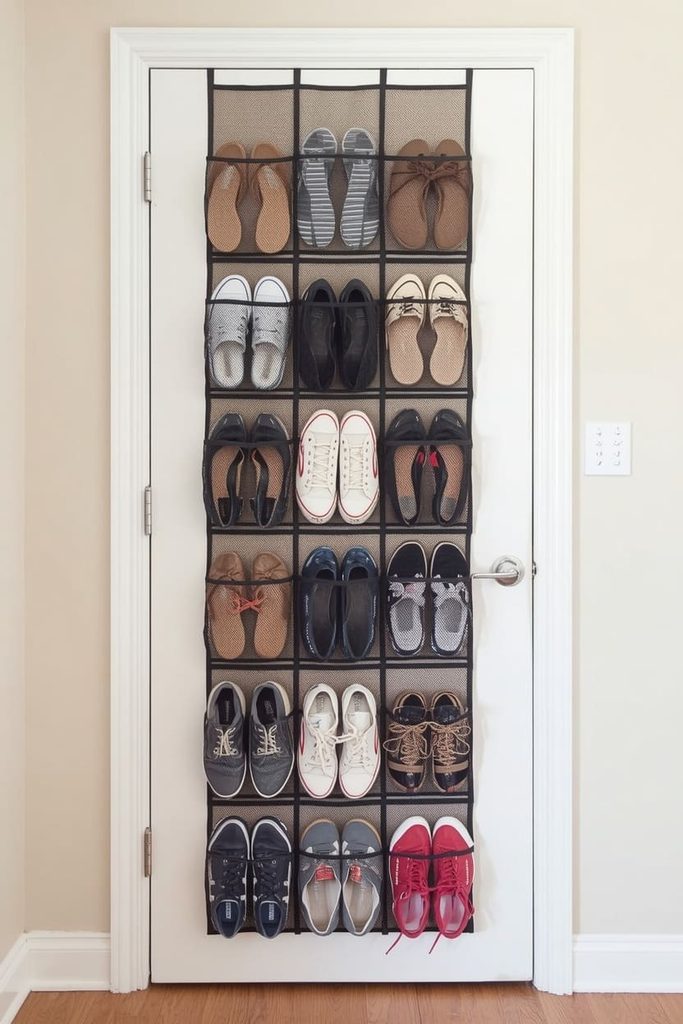
An over-the-door shoe organizer hangs on the back of any door and holds a dozen or more pairs without using an inch of your floor.
Floor space is the one thing small apartments never have enough of. A door, on the other hand, sits there unused all day. Turning it into storage solves your shoe problem without shrinking your living room.
Here’s how to set it up:
- Measure your door’s thickness before buying, since some racks only fit standard doors.
- Choose a mesh or pocket-style organizer, not a rigid shelf one, for tighter door frames.
- Hang it on the back of a closet door or bedroom door, not your front door, to keep the entryway looking clean.
- Sort pairs by how often you wear them, keeping daily shoes in the lowest, easiest pockets.
Tip: Look for organizers with padded hooks. Bare metal hooks can scratch or dent a rented door over time.
I hung one of these on my closet door the first week I moved in, mostly out of desperation. It’s still there two years later, and I’ve never had a landlord blink at it during an inspection. For something that took five minutes to install, it’s carried more shoes than any rack I’ve ever owned.
The Slim Corner Tower That Disappears Into a Hallway
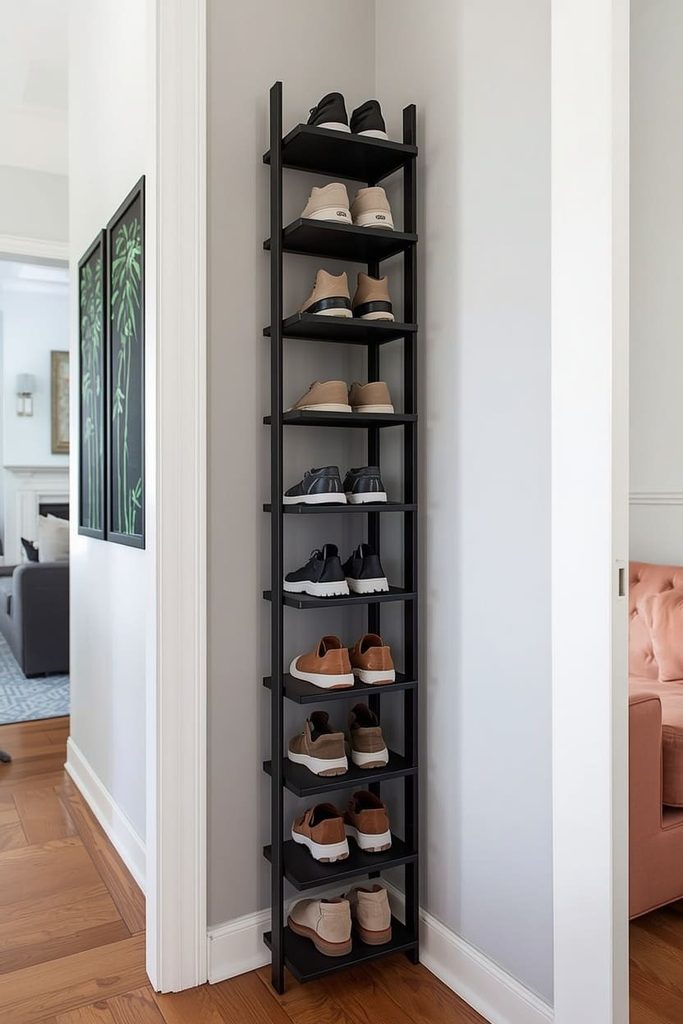
A tall, narrow shoe tower fits into a corner or slim hallway gap, holding several pairs while barely sticking out into your walking space.
Most shoe racks are built wide, which eats up exactly the kind of space small apartments don’t have. A slim vertical design solves that by going up instead of out.
To set this up:
- Measure the corner or gap where you want to place it, checking width more than height.
- Choose a tower with a narrow footprint, ideally under a foot wide.
- Place your most-used shoes on the lower shelves so you’re not reaching too high daily.
- Push it flush against a wall so it doesn’t block foot traffic.
This works especially well in narrow hallways, where a wide rack would force you to squeeze past it every day.
Tip: Pick a rack with an open-back design so air can flow through and shoes don’t trap moisture.
My old hallway was barely wide enough for two people to pass at once. A wide shoe rack would have made it worse, so I went slim instead. It fit into a gap I thought was completely useless, and now that dead corner holds six pairs of shoes I used to trip over daily.
The Rolling Cart That Hides Shoes Completely When Guests Come Over
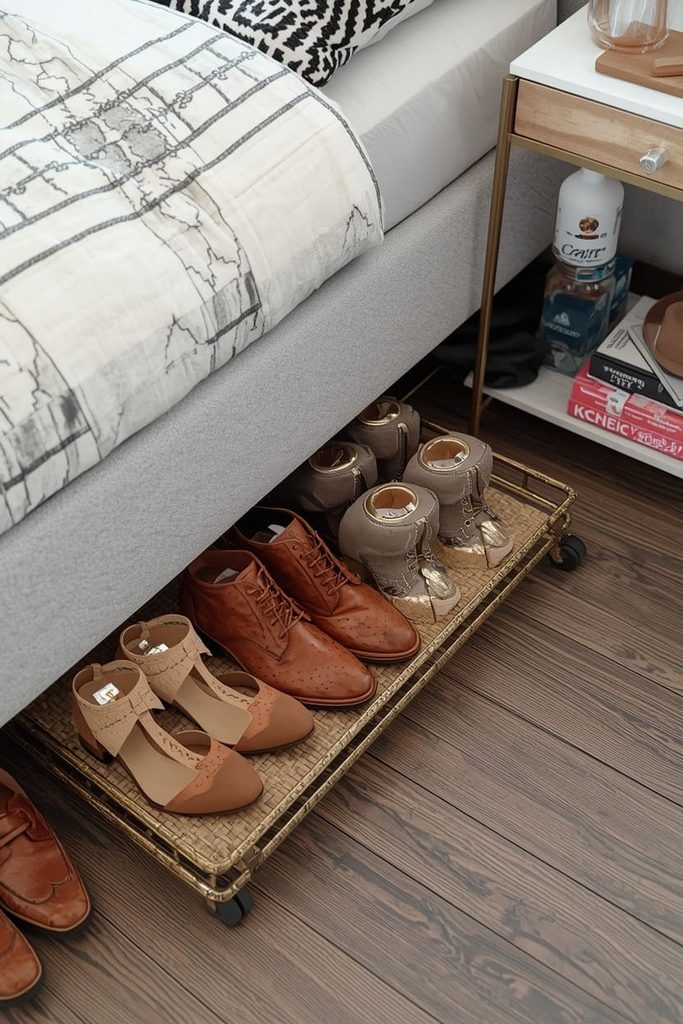
A rolling shoe cart tucks under your bed or a low shelf, letting you hide your entire shoe collection out of sight in seconds.
Small apartments often double as your only entertaining space. A visible pile of shoes isn’t just clutter, it’s the first thing guests see. A cart that rolls away solves both problems at once.
Here’s the process:
- Measure the clearance under your bed or shelf before buying a cart.
- Choose a low-profile cart with sturdy wheels that roll smoothly on your flooring.
- Load shoes in rows, heaviest pairs toward the back for balance.
- Roll it out only when you need it, then push it back out of sight.
Tip: Add a thin fabric cover over the cart if you store it somewhere visible, like under an open bed frame.
I started using a rolling cart after one too many friends commented on my “shoe corner” during a small get-together. Now I roll it out when I actually need a pair and push it right back under the bed when I’m done. Nobody visiting my apartment has any idea it’s there.
The No-Drill Wall Rail That Still Feels Permanent
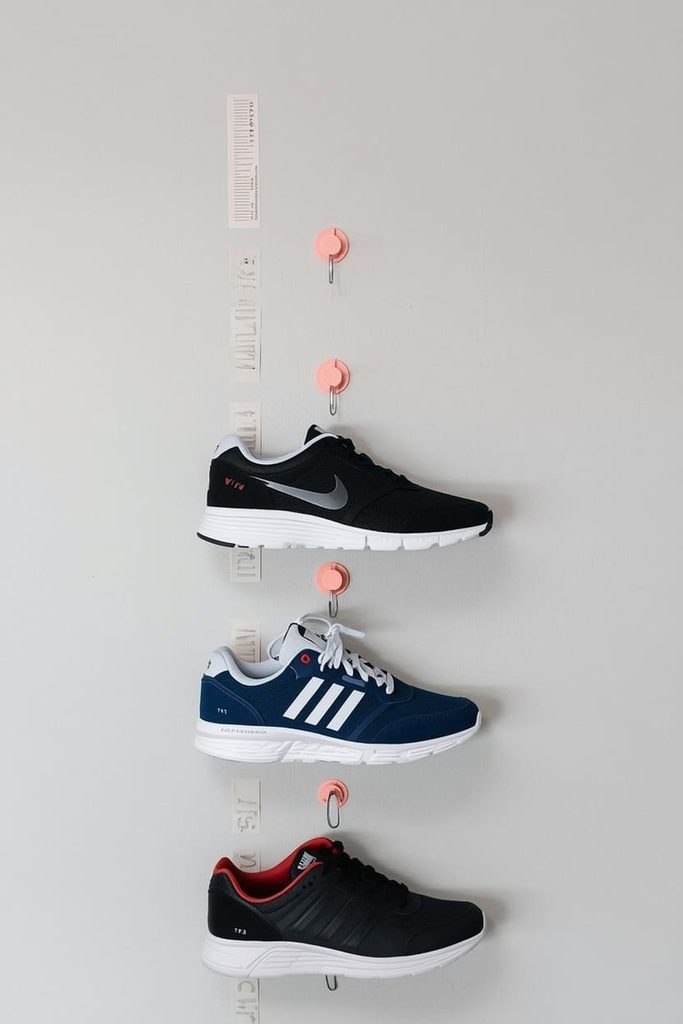
A no-drill adhesive hook rail mounts on any wall and holds a row of shoes, giving you wall storage without a single hole.
Renters often assume wall storage is off-limits entirely. Command-style adhesive hooks change that, holding real weight while still coming off clean at move-out.
Steps to install it:
- Clean the wall spot first. Adhesive strips fail on dusty or oily walls.
- Space hooks evenly, checking the weight limit listed on the package.
- Press each hook firmly and wait the full recommended time before hanging anything.
- Hang lighter shoes here, saving heavier boots for a floor-based option.
This gives you the look of built-in storage without needing your landlord’s permission or a single tool.
Tip: Test one hook with your heaviest shoe first before committing to a full row.
I was skeptical the first time I tried this, half expecting the strips to give out overnight. A full year later, the same hooks are still holding my sneakers, and I got my full deposit back when I moved out. That combination alone makes this option worth trying.
The Stackable Shelf System That Grows With Your Shoe Collection
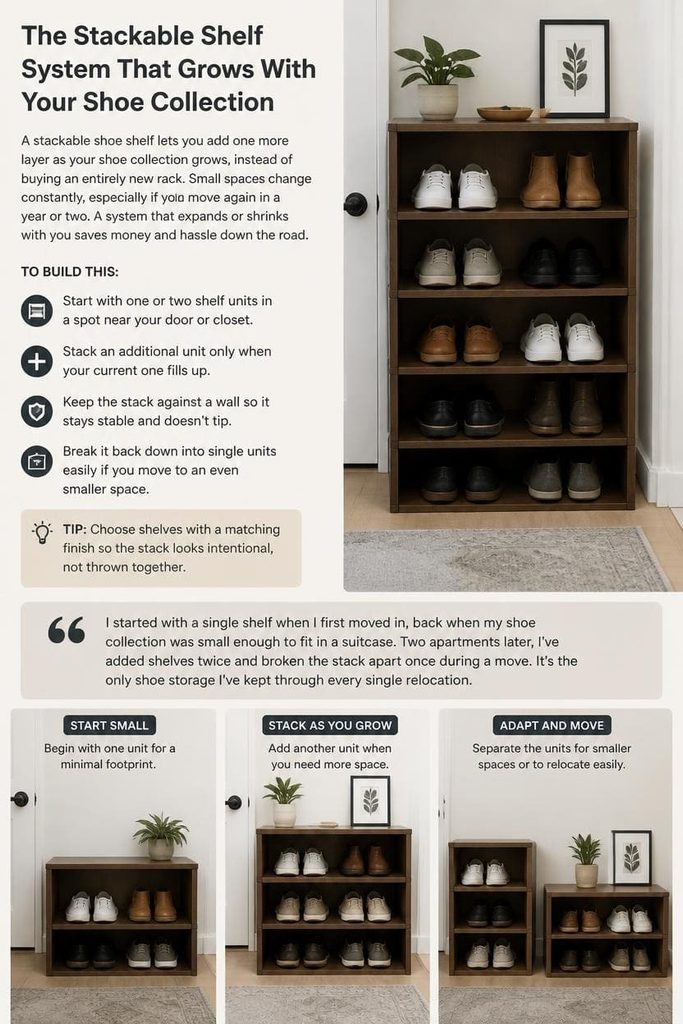
A stackable shoe shelf lets you add one more layer as your shoe collection grows, instead of buying an entirely new rack.
Small spaces change constantly, especially if you move again in a year or two. A system that expands or shrinks with you saves money and hassle down the road.
To build this:
- Start with one or two shelf units in a spot near your door or closet.
- Stack an additional unit only when your current one fills up.
- Keep the stack against a wall so it stays stable and doesn’t tip.
- Break it back down into single units easily if you move to an even smaller space.
Tip: Choose shelves with a matching finish so the stack looks intentional, not thrown together.
I started with a single shelf when I first moved in, back when my shoe collection was small enough to fit in a suitcase. Two apartments later, I’ve added shelves twice and broken the stack apart once during a move. It’s the only shoe storage I’ve kept through every single relocation.
How to Store Shoes Without Damaging Rental Walls or Floors
Every option on this list should leave your rental exactly as you found it.
Stick to adhesive hooks rated for the actual weight of your shoes, not just any hook you find. A rail rated for towels will not hold hiking boots.
Check the manufacturer’s weight limit per hook, then stay well under it if you’re hanging heavier shoes like boots. Overloading a hook is the number one reason these systems fail and leave marks behind when they fall.
Avoid anything with rubber feet or grippy pads directly on hardwood or laminate floors for long stretches. Some rubber can leave marks over time, especially in warm rooms. A thin felt pad underneath solves this in seconds.
Take photos of your walls and floors before adding any storage. It’s a small step that saves an argument with your landlord later.
I learned this one the hard way after a previous roommate blamed a floor scuff on my rolling cart, even though it happened months before I owned one. Now I snap a few photos the day I move in and again before I move out. It takes two minutes and settles any dispute instantly.
How Many Shoes You Can Realistically Store in a Small Entryway
Most small entryways can comfortably hold six to ten pairs without feeling cramped.
That number sounds low if you own more shoes than that, and most people do. The fix isn’t cramming everything into one spot. It’s splitting your shoes into “everyday” and “everything else.”
Keep only your most-used pairs in the entryway or by the door. Store off-season or rarely worn shoes somewhere else entirely, like a rolling cart under your bed or a bin on a closet shelf.
This keeps your main storage spot from turning into the exact clutter you were trying to avoid.
Think of your entryway like prime real estate. It’s the smallest, most valuable space in your home, so it should only hold what you actually reach for during a normal week. Everything else, no matter how much you love it, belongs somewhere less central.
A good rule of thumb is the one-in, one-out approach. When a new pair comes in, an old or rarely worn pair moves to your secondary storage spot. This alone keeps small entryways from slowly filling back up over time.
Frequently Asked Questions
What’s the best shoe storage for apartments with no closet? An over-the-door organizer or a slim corner tower works best. Both give you real storage without needing an actual closet.
How do I store shoes in a small entryway without it looking cluttered? Limit the entryway to your daily shoes only, six to ten pairs at most. Everything else belongs in a separate spot, like under a bed or on a closet shelf.
Can I hang shoe storage without damaging rental walls? Yes, adhesive hooks rated for your shoe weight work well and remove cleanly. Always check the weight limit before loading them up.
What’s the best shoe storage for a small hallway or narrow space? A slim vertical tower under a foot wide fits narrow hallways without blocking foot traffic. Push it flush against the wall for the least intrusive footprint.
Do rolling shoe carts work on carpet? Yes, but look for carts with larger wheels made for carpet use. Small, hard wheels can struggle to roll smoothly on thick carpet.
Will an over-the-door organizer damage my door? Not if you choose one with padded or rubber-coated hooks. Bare metal hooks are the main cause of scratches, so it’s worth checking that detail before you buy.
What if I have more shoes than any single solution can hold? Combine two ideas instead of relying on one. Many renters use an over-the-door organizer for daily shoes and a rolling cart for everything else, which covers far more pairs than either option alone.
A Small Space Doesn’t Mean a Shoe Pile Forever
You don’t need a mudroom or a landlord’s permission to get your shoes off the floor. Pick one idea from this list that fits your actual space, not your dream apartment, and set it up this weekend.
My own tiny apartment went from a shoe minefield to an organized entryway in one afternoon, without a single hole in the wall. It didn’t take a big budget or a big space, just the right system for the square footage I actually had. Yours can look just as put-together, starting today.

Sohel Rana is the writer, editor, publisher, and founder of The Tidy Porch. He is the man who is responsible for the craft (my wife created) being converted into a written piece. He also helps her wife (Sumona) by capturing videos of each craft. In short, he brings each craft created by her wife in front of you by transforming it into an article and a video.
