
Last December, I asked my four-year-old niece a simple question. “What makes you happy?” She thought for a second.
Then she said, “When the dog sneezes.” I laughed so hard that I wrote it on the back of my hand. I wanted to save that moment forever. That night, I made my first joy handprint craft.
Each finger holds one real answer in her own words. It still sits on my desk. It makes me smile more than any ornament I own. You can make one this week.
Why Does a Handprint That Holds a Child’s Words Make a Better Keepsake?
A handprint shows how big a child’s hand was, and the words show how that child thought. Together, they save a whole moment instead of just a size.
Hands grow fast. Favorite things change even faster. A four-year-old may love dog sneezes, and a six-year-old may love soccer. Years later, the words are the part grandparents read out loud and quote at dinner.
What Supplies Do You Need?
You need green washable paint, one sheet of cardstock, and a few markers. Here is the full list for one keepsake:
- White cardstock: one 8-by-10-inch sheet.
- Green paint: washable, non-toxic tempera. Use about 1 tablespoon per hand.
- Red paint: a pea-size dab for the berries. A red marker works too.
- Pencil with an eraser: the eraser makes a perfect berry dot.
- Foam brush and paper plate: one 1-inch brush and one plate.
- Fine-tip black marker: for the joy words.
- White or red marker: for the word JOY.
- Masking tape: to hold the card still.
- Cleanup: wet wipes, paper towels, and a bowl of warm soapy water.
- Optional: a hole punch and ribbon, or a frame.
How Do You Set Up Before You Start?
Cover the table, pour the paint, and set up a wipe-and-wash spot before the child sits down.
Tape a plastic tablecloth to the table. Pour 1 tablespoon of green paint onto the plate and spread it thin. Place a pea-size dab of red paint on the edge.
Write the child’s name, age, and year lightly in pencil along the bottom edge of the card. Doing this first means you will not forget it later.
How Do You Ask a Child What Brings Them Joy?
Ask one short question at a time, then wait. Write down the exact words, even when the answer sounds funny. Those words are what make the keepsake special.
Try questions like these:
- What makes you laugh the hardest?
- What is your favorite thing to do with Grandma?
- Which food makes you happy?
- Where do you love to play?
- What do you like best about winter?
Do the talking before the painting, while the child is relaxed. Jot the answers on a scrap list with five lines. If a child says “pancakes with Daddy,” write exactly that. If they only come up with two joys, offer a choice or give them a day to think.
Babies and young toddlers cannot answer yet. Watch them instead. Write five joys that you see, such as “bath splashes” or “Daddy’s silly face.” Title the card “Joys I noticed this year.” For a toddler, yes-or-no questions help: “Do you love bubbles?”
How Do You Make the Five Fingers of Joy Keepsake?
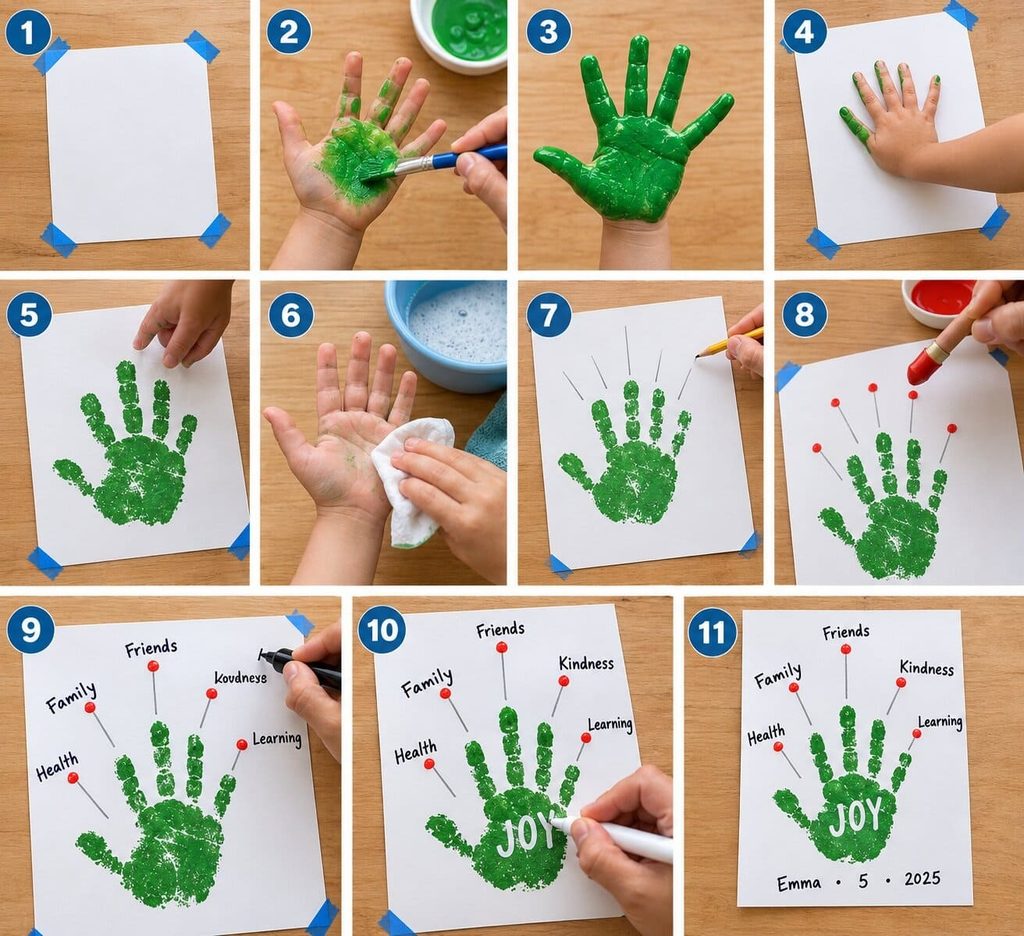
Paint the hand green, press it fingers-up on the lower half of the card, and then add five lines, five red berries, five joys, and the word JOY. Follow these steps in order.
- Tape the card. Place the 8-by-10-inch card upright on the table. Tape all four corners so it cannot slide.
- Paint the hand. Have the child hold a hand palm up. Brush a thin layer of green over the palm, thumb, and all four fingers. If the paint looks see-through, add one more light coat. Thick paint makes blobs.
- Spread the fingers. Open the hand wide with the thumb out to the side. Fingers should point toward the top of the card.
- Press and hold. Lower the hand slowly onto the lower half of the card. Center it, and leave about 1½ inches below the heel of the hand for the footer. Press the palm first, then each finger. Count to five. For a baby, open the hand gently and hold the wrist.
- Lift straight up. Pull the hand away in one smooth move. If a finger smears, let it dry. Then dab the stray edge with white paint.
- Clean up and wait. Wipe the hand right away, then rinse it in the soapy bowl. Let the card dry flat for 15 to 20 minutes.
- Draw the lines. In pencil, draw one line above each fingertip. Make each line 1½ to 3 inches long. Vary the lengths and angle them outward like sun rays. This gives each joy its own space.
- Add the red berries. Dip the pencil eraser in red paint. Press one dot at the end of each line. The dots should be about ¼ inch wide. Let them dry for five minutes.
- Write the joys. Use the fine-tip black marker. Write one joy beside each berry, using 2 to 4 words in letters about half an inch tall. Pencil the words first if you worry about space. Trace the pencil lines in black marker too.
- Write JOY. Make sure the green is fully dry. Then write JOY in the palm with a white marker. Letters about 1 inch tall fit most preschool hands. On a baby’s smaller palm, write it above the hand instead.
- Trace the footer. Go over the pencil name, age, and year along the bottom with the black marker.
Frame it, punch two holes near the top and hang it on ribbon, or tuck it inside a card.
How Can You Make It for a Class, a Family Gift, or a Church Group?
Prepare the cards and paint ahead, talk with children in small groups, and let a helper handle the writing. This keeps a group moving.
For a class of 20, one 16-ounce bottle of green paint covers every hand with some left over. Set up four stations in a line: talk, paint, press, wash. Parent volunteers can write each child’s joys while you run the paint.
Sunday school and church-group leaders can use the same steps for an Advent lesson about joy. As a family gift, let each sibling make one. Tape the cards side by side for the grandparents.
What Changes for Babies, Toddlers, Preschoolers, and Kindergartners?
Babies need a parent for every step, and kindergartners can do almost all of it.
Babies (under 1): You do everything. Use “Joys I noticed this year.”
Toddlers (ages 1 to 3): You guide the press. Offer yes-or-no questions, and write what they say or show.
Preschoolers (ages 3 to 5): They can answer the questions and add the berries. You do the writing.
Kindergartners (ages 5 to 6): They can write their own joys, in their own spelling. Keep it. It is part of the charm.
How Do You Keep, Date, and Repeat the Tradition?
Write the name, age, and year on every keepsake, store it flat, and make a new one each December. The date is what turns one craft into a growing record.
Slide each card into a clear sleeve in a binder. Photograph it before you hang it so far-away grandparents can see it. Each year, lay the old card next to the new one. You will see the hand grow and the joys change.
What Mistakes Should You Avoid?
Most problems come from too much paint, rushed drying, or fixing the child’s words.
- Thick paint: It gives a lumpy print. Spread it thin and blot extra on a paper towel.
- Writing too soon: Wet paint smears the marker. Wait the full 20 minutes.
- Correcting the words: A child’s spelling and grammar are part of the keepsake. Leave them.
- Writing too large: Big letters run out of room. Keep them half an inch tall.
Frequently Asked Questions
What age is this craft best for?
It works from babies to age 6. Babies need full help, and kindergartners can write their own joys.
What if my child can only think of one joy?
Offer a choice, such as “Do you like bubbles or books?” You can also leave a finger blank and add the joy later.
What paint is safest?
Choose washable, non-toxic tempera made for kids. If you worry about sensitive skin, test a small dab on the child’s hand first.
How long does it take?
Plan on 10 minutes for the interview and painting. Drying takes 15 to 20 minutes. Writing the words and finishing touches take another 10.
How do I make it for a whole class?
Set up four stations and let volunteers write the words. One 16-ounce bottle of green paint covers 20 hands.
Can I make this without paint?
Yes. Trace the child’s hand on green paper and cut it out. Glue it to the card. Add the lines, berries, words, and JOY the same way.

Sohel Rana is the writer, editor, publisher, and founder of The Tidy Porch. He is the man who is responsible for the craft (my wife created) being converted into a written piece. He also helps her wife (Sumona) by capturing videos of each craft. In short, he brings each craft created by her wife in front of you by transforming it into an article and a video.
